If you’re aiming to strengthen your Python skills with solid object-oriented programming (OOP) foundations, this guide highlights five top books. Each title covers core OOP concepts, design practices, and practical projects to reinforce learning. Explore hands-on approaches, from game and GUI development to scalable app architectures, to build a robust OOP toolkit.
| Book | Author/Authors | Focus |
|---|---|---|
| Object-Oriented Python | Irv Kalb (Author) | OOP fundamentals through games and GUIs |
| Python Object-Oriented Programming (OOP) | Steven F. Lott, Dusty Phillips | When to apply OOP for scalable Python apps |
| Murach’s Python Programming | Joel Murach (Author) | Comprehensive Python with OOP, databases, GUIs |
| Absolute Beginner’s Guide to Python | Various Authors | Beginner-friendly, real-world projects, step-by-step |
| Python Programming for Beginners | Various Authors | No-fluff guide with practical coding strategies |
This selection covers a range of approaches—from project-based OOP practice to structured curricula—helping readers compare how each author teaches object-oriented design, class hierarchies, and design patterns within Python. The books are well-suited for learners who want tangible, hands-on experience and guidance on applying OOP in real-world projects.
Object-Oriented Python: Master OOP

This book emphasizes practical OOP through interactive projects, including game and GUI development. It breaks down core concepts such as classes, inheritance, encapsulation, and polymorphism with concrete Python examples. Readers gain a hands-on understanding of how to structure programs, reuse code, and design flexible interfaces. The author highlights common pitfalls and patterns that improve code readability and maintainability, making it a solid pick for developers aiming to solidify their OOP foundation.
Python Object-Oriented Programming
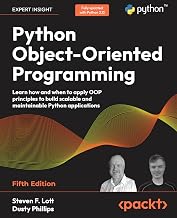
This title presents a practical perspective on when and how to apply OOP principles to build scalable Python applications. It covers design decisions, class relationships, and the trade-offs between composition and inheritance. The authors provide clear guidance on structuring larger projects, unit testing object-oriented code, and leveraging Python’s features to maintainable, extensible software systems.
Murach’s Python Programming

Murach’s guide offers a comprehensive path from beginner to advanced Python concepts with a strong emphasis on object-oriented programming. The book blends clear explanations with step-by-step instructions on OOP design, data handling, and GUI development. It’s well-suited for readers who appreciate structured lessons, practical examples, and progression through increasingly complex topics, including database interactions and object-oriented design patterns.
Absolute Beginner’s Guide to Python

Aimed at beginners, this guide emphasizes hands-on learning through real-world projects. It covers Python basics, object-oriented concepts, and practical exercises designed to reinforce understanding. The approachable style helps readers progress at a steady pace while building confidence in applying OOP ideas to simple programs and gradually more complex systems.
Python Programming for Beginners

This beginner-oriented title emphasizes actionable coding techniques and quick-start projects. It helps readers move from basic syntax to practical object-oriented programming patterns, with clear explanations of classes, objects, and simple design principles. The book’s project list supports a steady progression from fundamentals to more intermediate constructs, making it a solid companion for those new to Python and OOP concepts.
Buying Guide
When selecting a Python OOP book, consider the following factors:
- Depth vs. pace: Choose a book that matches your current knowledge and preferred learning pace. Beginners may favor guided projects, while intermediate learners may want deeper coverage of design patterns and scalable architectures.
- Project emphasis: Books with hands-on projects—games, GUIs, or databases—tend to reinforce OOP concepts more effectively than theory alone.
- Practicality: Look for real-world examples showing how to structure code, test object-oriented classes, and apply composition versus inheritance decisions.
- Language features: Ensure the book covers Python’s modern features relevant to OOP, such as data classes, properties, and class methods, while clarifying when to use them.
- Audience alignment: Some titles target beginners with step-by-step steps; others suit developers expanding into larger, maintainable systems.
To compare approaches, assess whether the book provides code samples you can run, exercises you can complete, and explanations that connect OOP theory to practical outcomes. For readers aiming to build robust, scalable Python applications, a balanced mix of fundamentals, patterns, and project-based practice is ideal.