Finding the right starting point for algebra can shape how smoothly students progress to intermediate topics. This guide highlights five educational products that pair well with early to mid-level algebra study, offering hands-on practice, structured rules, and complementary resources. Each entry includes a quick snapshot of its relevance to foundational math learning, plus how it can support classroom or self-study environments.
| Product | Brand | Relevance to Algebra |
|---|---|---|
| Games Workshop – Warhammer 40,000: Introductory Set | Workshop | Strategic rules and measurement practice can reinforce logical thinking and spatial reasoning used in algebra. |
| Introductory Sommelier Course 2019 Workbook | Melissa Monosoff MS (Author); Fernando Beteta MS (Illustrator) | Structured learning with stepwise progressions mirrors algebraic practice sets and problem-solving skills. |
| Games Workshop – Warhammer – Age of Sigmar: Introductory Set (2025 3rd Edition) | Workshop | Rule basics and measurement concepts can parallel variable tracking and equations in early algebra. |
| Introductory Lectures on Psychoanalysis | Sigmund Freud (Author); James Strachey (Author) | Structured argumentation and theory outlines provide modeling of logical reasoning used in proofs. |
| Lecture Tutorials for Introductory Astronomy | Ed Prather (Author); Gina Brissenden (Author); Colin Wallace (Author); Jeffery Adams (Author) & 1 more | Scientific data interpretation and graphing basics align with algebraic data analysis tasks. |
Introductory Warhammer Set for Learning Strategy and Measurement
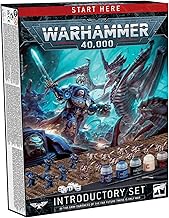
The Warhammer 40,000 Introductory Set includes the basic rules, dice, a gaming mat, reference sheets, and a range ruler. While marketed for gameplay, learners can use the included reference materials to map out step-by-step problem-solving approaches and to practice translating problems into procedural steps—an essential skill in introductory algebra. The set encourages measurement, spacing, and sequencing, which align with early algebraic thinking about variables, expressions, and equations.
Introductory Sommelier Course 2019 Workbook

This workbook offers structured, progressive lessons that mirror the scaffolded approach seen in algebra curricula. Although focused on wine education, the content emphasizes stepwise problem solving, data interpretation, and rule-based thinking. Students can transfer these skills to solving algebraic equations, simplifying expressions, and applying logical sequences to word problems. It serves as a model for systematic practice and concept reinforcement outside math alone.
Warhammer Age of Sigmar: Introductory Set

The Age of Sigmar introductory set emphasizes basic rules, unit interactions, and strategic thought. The beginner-friendly content can reinforce algebraic thinking through pattern recognition, problem framing, and stepwise rule application. While not a math textbook, it provides an ambient learning environment where mathematical ideas—such as counting, sequencing, and proportional reasoning—emerge naturally during play and strategy development.
Introductory Lectures on Psychoanalysis

Freud’s introductory lectures present structured theoretical material with clear progression from foundational concepts to more complex ideas. The organization and logical flow can help learners develop disciplined reading and note-taking strategies, which support the absorption and application of algebraic principles like variables, functions, and graphical interpretation in a methodical way.
Lecture Tutorials for Introductory Astronomy

This resource provides tutorials that blend data interpretation with graphical representation, mirroring the way algebra translates numerical information into meaningful expressions and equations. Learners can practice extracting patterns from observations, constructing models, and validating them—core activities in algebraic problem-solving and data analysis. The collaborative tutorials can also support group study environments where ideas are tested and refined.
Buying Guide: Key Considerations for Choosing Algebra Study Aids
- Learning goals: Align the product’s focus with your current algebra level—foundational practice, problem-solving strategies, or data interpretation skills.
- Format and accessibility: Consider whether you prefer print-like structure, digital access, or classroom-friendly materials that support group work.
- Practice structure: Look for resources offering clear, incremental steps, with examples and end-of-chapter exercises to reinforce concepts.
- Measurement and reasoning: Materials that emphasize units, scales, and proportional reasoning can reinforce algebraic thinking and real-world application.
- Supplementary tools: Rulers, reference sheets, or problem-solving checklists can help with procedural fluency and self-checking.
- Cross-d-disciplinary value: Items that encourage logical reasoning, data interpretation, and structured arguments can support math learning beyond algebra alone.
- Age and experience level: Choose resources that match the student’s current understanding while providing growth opportunities toward intermediate topics.